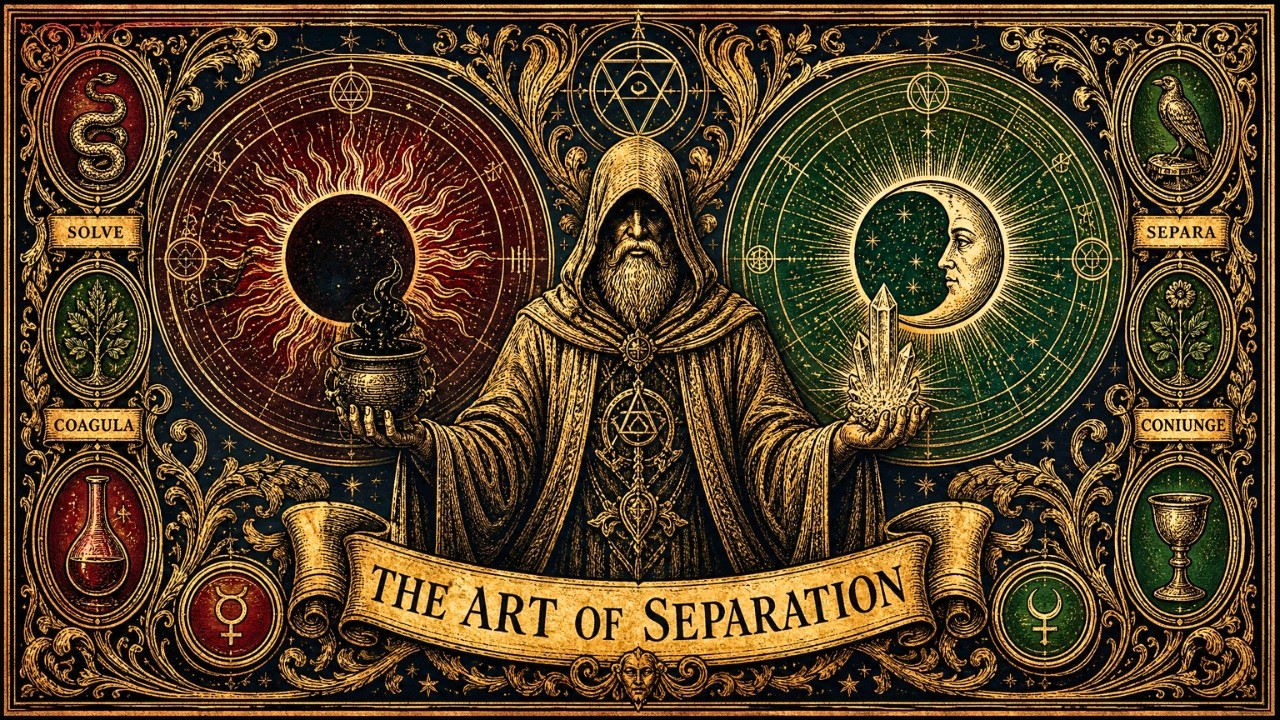
Separatio — The Alchemical Cut That Removes What You Were Never Supposed to Keep (Alchemy & Jung)
Every human life begins in an unexamined state of mass confusion — a psychological twilight zone the ancient alchemists termed the massa confusa. In this initial condition, you do not possess your experiences. Your experiences possess you. We move through the modern world under the comforting, yet utterly fraudulent illusion that our minds are singular, unified, and entirely within our control. But beneath the fragile surface of the conscious ego lies a chaotic, churning ocean of unexamined conditioning, inherited trauma, and psychic debris.
The tragedy of the modern individual is not that they are broken, but that they are fused to things they were never meant to carry. We spend the first half of our lives accumulating psychological weight — titles, expectations, social programming, toxic attachments — mistaking this growing pile of spiritual ballast for the construction of a self. We cling to dead relationships, obsolete versions of our identity, and neurotic patterns of behavior, believing that to let go of them would be equivalent to our own death. And in a sense, it is. It is the death of the false self.
The great illusion of humanity is that we can grow by addition. The bitter truth of the Great Work is that we can only find ourselves through subtraction.
This is not an invitation to a comfortable self-help exercise. It is a rigorous examination of the most painful, violent, and necessary operation in the entire alchemical lexicon: Separatio — the deliberate, surgical severing of the authentic core of your being from the parasitic growths that have masqueraded as your identity for decades. If you look closely at the mechanics of this operation, you will be forced to confront a terrifying question. Who are you when everything you have used to define yourself is stripped away? The answer cannot be intellectualized. It must be lived, endured, and extracted from the fire — the same fire described in every personal collapse that follows the alchemical pattern written into the human psyche.
The Massa Confusa: The Chaos You Mistake for Self
To understand the psychological gravity of Separatio, we must transcend the literal, material misunderstandings of medieval chemistry and enter the conceptual realm of the Opus Magnum, the Great Work. The alchemists were not eccentric proto-scientists trying to turn lead into gold. They were intuitive depth psychologists who mapped the labyrinth of the human soul using the language of matter. At the core of their doctrine lay a foundational realization: before any true gold can be manifested — before an individual can achieve psychological wholeness or spiritual sovereignty — the raw material must undergo a brutal process of division.
In the alchemical laboratory, Separatio represents the moment where the undifferentiated, chaotic sludge within the crucible is subjected to a precise application of heat, acidity, or mechanical force. The goal is simple yet radical: to isolate the pure elements from the impure dross. You are not a monolith. You are a crowded room of competing voices — a psychological conglomerate of everything you have ever absorbed from a world that demanded your compliance before you ever had the chance to discover your autonomy.
Participation Mystique: The Fusion Before the Cut
In the vocabulary of the Swiss psychiatrist Carl Gustav Jung, who spent the latter half of his life decoding alchemical treatises, this process of division is the exact symbolic equivalent of individuation. Jung recognized that the human psyche begins its journey in a state of psychological undifferentiation he called participation mystique — a mystical identity in which the individual's ego is completely fused with the collective unconscious, the family unit, and societal expectation.
The doctrine of Separatio asserts that true consciousness cannot exist without discrimination. To discriminate means to see things as they actually are, divided into their constitutive parts, rather than merged in a cloud of unconscious projection. When you are angry, are you truly angry, or are you acting out the unprosecuted rage of an absent parent? When you pursue a career, are you driven by a genuine internal calling, or are you desperately attempting to soothe an existential insecurity planted within you by a hyper-competitive culture? Without Separatio, you remain a psychological amalgam — a chemical compound, stable only until an external crisis shatters your environment and forces an uncontrolled reaction.
The alchemist does not wait for life to accidentally break the crucible. They take up the knife of philosophical analysis and initiate the cut themselves. This is the same sovereignty explored in the alchemical death of the false self — the refusal to remain a passive actor in a pre-written script.
Withdrawing the Projection
This operation requires an unwavering intellectual honesty that borders on cruelty toward one's own ego. It demands that we look at our most cherished narratives — our victimhood, our moral superiority, our self-imposed limitations — and recognize them as the waste products of a psychological process that must be discarded. The classical texts call this separating the volatile from the fixed, the subtle from the gross. The gross represents the heavy, unreflective aspects of our nature: base instincts, social conditioning, defensive reactions. The subtle is the spark of objective awareness — the observing ego capable of witnessing the storm of human emotion without being swept away by it.
Once the outer shell of identity cracks, under what the alchemists called the calcination of the ego, the psychological contents begin to liquefy. This is the alchemical solutio. Here, the rigid certainties of the intellect dissolve into the waters of the unconscious, and you begin to realize that the enemies you have fought in the external world — the people who have wronged you, the institutions that have oppressed you — are in large part projections of your own unacknowledged shadow. The analytical mind must here perform a delicate operation: it must withdraw these projections from the external world and bring them back into the laboratory of the self.
You must stop blaming the mirror for the reflection it shows you. What part of my own disowned nature am I seeing in the person who angers me most?
This step is crucial, because as long as your psychological energy remains bound up in external battles, you stay hopelessly fused to the very things you wish to escape. The knife of Separatio must cut the umbilical cord of projection, forcing you to look inward for both the source of your suffering and the mechanism of your liberation — the same law of self-containment examined in the Hermetic law of the silent observer.
The Alchemical Cut: Boundaries as Surgery
Here we reach the epicenter of the Great Work. The elements have been heated and liquefied. Now they must be decisively divided — the literal application of the alchemical blade. In your psychological life, this manifests as the courage to draw absolute boundaries. It is the moment you say no to a dynamic, a habit, or a relationship that sustains your lower nature, even when that no causes immediate pain, social disruption, or loneliness.
This is the stage where you deliberately choose the discomfort of growth over the numbing safety of stagnation. It involves a profound mourning process, for you are not merely cutting away things you hate. You are cutting away things you once loved — things that provided comfort, validation, and a sense of belonging. You are amputating a part of your history so that the rest of your soul might live. This is the extraction of sulfur, the fiery essential will, and mercury, the fluid intuitive consciousness, from the dead salt of past conditioning.
Once the cut is made, the isolated elements must be purified through what alchemy calls distillation — a liquid repeatedly boiled, evaporated, and condensed until it reaches its highest state of purity. Psychologically, this corresponds to a period of intense introspection and solitude. Having cut yourself free from the collective noise, you must now sit with the raw essence of your being. This is where you discover your true values, independent of societal consensus — and why it becomes almost impossible to keep explaining your transformation to people who haven't been through it.
Nigredo: The Black Sun and the Terror of the Void
No true transformation occurs without a descent into the underworld. In the alchemical tradition, this phase is known as the Nigredo, or the Black Sun. It is the inevitable dark night of the soul that follows the execution of Separatio. When you cut away the false structures of your life, you do not immediately step into a state of enlightened bliss. Instead, you enter a profound, terrifying void. The structures you destroyed were the very things that gave your life meaning, structure, and predictability. Without them, the world appears gray, meaningless, and radically indifferent to your existence.
This is the point where the vast majority of seekers fail. Faced with the absolute silence of the Nigredo, the terror of isolation becomes too great to bear. The ego panics and desperately tries to undo the operation — crawling back into the toxic relationships it just abandoned, rushing to fill the void with new distractions, new addictions, or new forms of ideological certainty. It prefers the comfortable slavery of the massa confusa to the terrifying freedom of the wilderness. This is precisely the stage mapped in Putrefactio, the stage where everything you built appears to collapse, and in transmuting depression as a psychological necessity rather than a malfunction.
The darkness is not the absence of light. It is the dissolution of the artificial lights you have been using to blind yourself to reality.
To survive the Nigredo, one must possess a rare form of philosophical courage — what the existentialists called the courage to be in the face of nothingness. You must understand that the depression, the emptiness, and the anxiety you feel are not signs that the process has gone wrong. They are signs that the process is working with mathematical precision. The alchemical knife has cut through your illusions, and now you must sit in the ruins of your old world until your eyes adjust to the darkness. For a fuller map of this stage, see the complete Black Sun shadow dissolution and the secret power hidden inside it — and remember what governs its length: the Hermetic law of natural timing. The crucible cannot be rushed.
Albedo: The Whitening Dawn
If the crucible is held steady, if the heat is maintained, and if the practitioner refuses to flee from the terror of the Nigredo, a miraculous transformation begins to unfold. The darkness begins to break. In the classical texts, this is heralded by the Albedo, the whitening — a dawn that rises within the psyche, bringing with it a profound sense of clarity, coolness, and peace. The elements that were separated during the operation are no longer in conflict. They have been purified, clarified, and are now ready for a higher, more conscious form of synthesis: the coniunctio, the sacred marriage of opposites.
This inner clarification is not merely psychological. It is visible. It changes how a person carries themselves, how they speak, even how they age — a phenomenon explored at length in why people who have integrated their shadow look younger than those who never separated themselves from the mask.
The Sovereign Self: What Cannot Be Taken
The self that emerges from this process is fundamentally different from the one that entered it. You do not return to the world as a detached, unfeeling ascetic, nor do you become an omnipotent hero of popular self-help mythology. Instead, you emerge as a sovereign individual. You are no longer at the mercy of your environment, your conditioning, or your unconscious complexes. The things you cut away are gone forever, and with them has gone the capacity for those things to manipulate your emotional state. You have removed what you were never supposed to keep, and what remains is that which cannot be destroyed by fire, time, or social pressure.
Integration does not mean re-fusing with your old illusions. It means entering the world with a permanent internal boundary. You can now engage with relationships, careers, and social structures without becoming possessed by them. You use them. They do not use you. You are capable of deep empathy because you no longer confuse the emotions of others with your own. You are capable of radical action because your will is no longer fractured by internal contradictions.
You have achieved what the alchemists called the lapis philosophorum, the philosopher's stone — a psychological center of gravity so stable, so refined, and so grounded in reality that it remains unshakable amidst the chaos of the changing world. You have found the gold within your own nature, and it is a gold that no one can give you and no one can take away, which is precisely why after this, nothing and no one will ever have power over you again. The completed circuit of this transformation — cutting away, descending, purifying, and returning whole — is itself the Ouroboros paradox: the self that must die in order to become the self that endures.
True power is never found in what you gather, what you inherit, or what the world convinces you to hold on to. Real sovereignty belongs exclusively to the consciousness that has been refined in the fire of its own isolation.
Separatio is not a metaphor to be admired from a safe intellectual distance. It is a summons. The knife is already in your hand, resting on the surface of every attachment you have been too afraid to name. The only question the Great Work ever asks is whether you will pick it up yourself, or wait for life to do it for you — the same hermetic knowledge that is disappearing from a culture too distracted to remember it was ever taught.
Go Deeper
Watch the complete teaching with visual symbolism and guided reflection on our YouTube channel.
Watch on YouTube Explore Ebooks