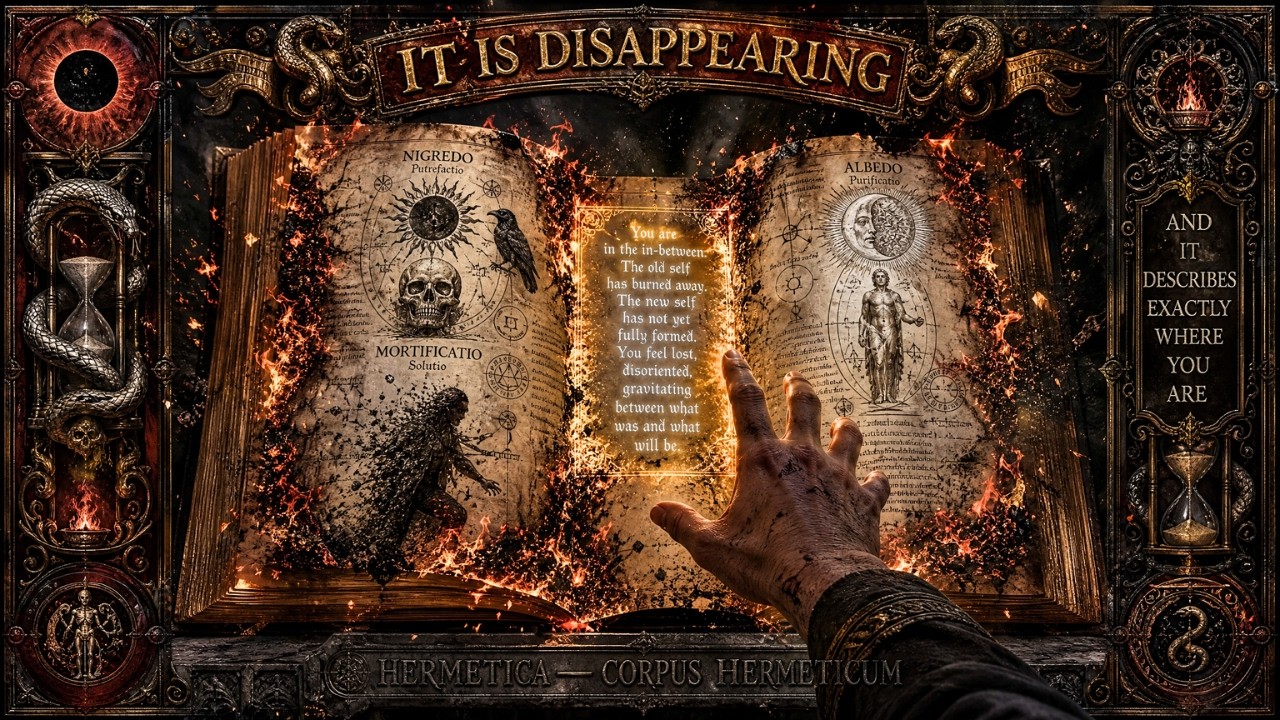
The Hermetic Knowledge That Is Disappearing — And What It Says About the Stage You Are in Right Now
The human psyche rarely signals its collapse with a scream. Instead, it chooses silence. An observer watching you navigate your daily routine would see absolutely nothing out of the ordinary — a person waking up at the usual hour, answering messages with practiced courtesy, moving through the world with quiet efficiency. But beneath this calm exterior, a subtle and deeply psychological shift has already begun to unfold.
You look at the things that used to define your identity — your career ambitions, your social circles, the specific anxieties that once kept you awake — and you feel absolutely nothing. It is as if you have been handed the script to a play you no longer wish to act in, yet you are forced to stand on stage pretending you still care about the performance.
This is not a simple case of modern exhaustion. It cannot be cured by a vacation or a temporary retreat from responsibilities. The terrifying reality you are trying to ignore is that a part of you has already passed away, and your conscious mind is simply lagging behind the funeral procession. You are experiencing the initial quiet erosion of the ego — an invisible threshold that ancient Hermetic alchemy understood as the ultimate turning point of human existence.
The Psychological Fracture
The transition begins with a strange, unshakable sense of artificiality. You walk into a familiar room, look at the objects you gathered over years of effort, and find yourself wondering who exactly bought them. The desires that drove your younger years suddenly look like museum artifacts — relics of a person you used to know intimately but can no longer fully recall.
You find yourself sitting in social settings, listening to people discuss their plans and grievances, and an invisible wall descends between you and the room. You can hear their voices. You can mimic the appropriate facial expressions. But you are no longer truly there.
This is the psychological fracture — the moment the ego realizes its tools no longer work on the reality it has constructed. In modern clinical settings, this is often misdiagnosed as an emotional deficit or a chemical misfiring. But the ancient masters viewed this state through an entirely different lens. They recognized that before any true structural reorganization can occur within a human soul, the existing architecture must first become completely uninhabitable.
Consider the physical sensations that accompany this stage. There is a specific weight in the chest, a persistent fatigue that sleep cannot remedy. You are not tired because you are doing too much. You are tired because you are pretending to be someone who no longer exists. Every word you speak in your old social role requires an immense conscious output of energy. You begin to crave isolation — not because you hate the world, but because the world keeps demanding that you produce a version of yourself that has already dissolved.
And here lies the first disturbing realization: you cannot go back. You cannot force yourself to care about the things that once thrilled you. You cannot reignite an obsession with status, validation, or superficial security once the mechanism behind those desires has been exposed as an illusion. The fracture breaks in one direction only.
The Nigredo: Entering the Blackness
Carl Jung spent the latter half of his life studying this exact internal crisis, finding its perfect symbolic map in the bizarre texts of medieval alchemists. Jung warned that the modern world would suffer a collective nervous breakdown precisely because it threw away the symbolic language required to understand internal destruction.
When you lose your sense of meaning, modern society tells you to fix your habits. Jung, however, would look at your isolation and tell you that you are entering the Nigredo — the blackness. The alchemists understood that you cannot transform a base metal into gold without first reducing it to its raw, unformed, charred essence. The material must be burned until it turns into black ash — the domain of the Black Sun.
In psychological terms, this means your ego — the neatly packaged image you present to the world — must be thoroughly dismantled. Most people mistake this phase for a personal failure. They look at their lack of ambition, their sadness, and their sudden detachment, and they believe they are broken. But Jung issued a deeply unsettling warning: the shadow does not appear when you are happy. It appears when your conscious ideals fail.
If you attempt to cure this darkness by forcing yourself back into your old persona, you risk permanent psychological stagnation. The ego must genuinely believe it is dying — because to the ego, loss of control is death.
The Execution of the False Self
This is the part nobody talks about in mainstream psychology. The alchemical process is not a self-help strategy designed to make you more productive or more attractive to society. It is an execution. The person you think you are must be sacrificed so that the person you are meant to become can inherit the psyche.
When you feel that deep, unnameable dread late at night — the feeling that your life is slipping through your fingers — you are not experiencing an illusion. You are experiencing the literal, objective death of your false self. The alchemists called this mortificatio: the stage where the psychic material becomes putrid, smells of decay, and offers absolutely no comfort.
This process mirrors the alchemical pattern of personal collapse documented two thousand years ago — a geometry of dissolution that repeats with mathematical precision across every genuine transformation.
And this is where most people panic. When the external world loses its grip on your attention, your gaze is forced inward — down into a vast, silent, and terrifyingly empty space.
The Internal Void
The internal void is not merely the absence of thoughts. It is the presence of an immense waiting silence. For decades, you used noise, notifications, social obligations, career milestones, and constant mental chatter to drown out this underlying emptiness. But now the noise has lost its power to distract you.
Something stranger begins to happen. As you linger in this void, you begin to experience reality with an intense, almost hyper-realistic detachment. You notice the underlying motives of the people around you with terrifying clarity — their manipulations, their desperate needs for validation, their fears — not with malice or judgment, but with a quiet, heartbreaking neutrality. You see the same patterns in yourself, recognizing how much of your life was driven by an unacknowledged terror of being invisible.
Time changes its shape. Hours can pass while you stare at a wall — not locked in anxious rumination, but suspended in a state of quiet fascination. The future, which used to be a canvas for your anxieties and hopes, becomes completely blank. You cannot project yourself into next year or even next month, because the entity that would inhabit that future is currently dissolving.
This is the stage where profound loneliness manifests. A unique brand of isolation that cannot be cured by human companionship. You could be surrounded by a family that loves you, friends who support you, and a partner who listens to your every word — yet you will still feel as though you are speaking a language from a completely different planet. You realize that no one can accompany you into this specific dark room. It is a solo descent.
Synchronicity and the Living Mirror
During this descent, synchronicity often begins to replace logic. A book drops off a shelf containing the exact phrase you were thinking of. A sudden encounter with a person from your past arrives just as you were remembering a specific trauma. A recurring symbol in your dreams seems to comment directly on your waking paralysis.
The Hermetic texts explain this by stating a fundamental law: As within, so without. When the internal tectonic plates of the psyche begin to shift, the external world cracks open to reflect the movement. The universe stops behaving like a collection of random objects and starts behaving like a living, intelligent mirror.
But do not mistake these synchronicities for comfort. They are road signs in a desert — confirming that you are lost exactly where you are supposed to be lost. The internal void demands total capitulation. If you attempt to fill it with new hobbies, new relationships, or sudden lifestyle changes, the void will simply swallow those attempts whole and grow larger. It wants nothing less than your complete surrender to the silence.
The Shadow's Final Stand
The pressure inside the crucible eventually reaches an intolerable peak. This is the moment of maximum resistance — where the ego realizes it is not just being asked to change, but to step down from the throne entirely.
The false self — the complex web of defense mechanisms, adapted personality traits, and inherited generational traumas you called your "character" — fights for its life. It fights by generating waves of profound, unadulterated terror. You may experience sudden surges of panic, a feeling that you are losing your mind, or an overwhelming urge to abandon everything you have built and run away.
This is the shadow making its final desperate stand. It uses your deepest insecurities against you, whispering that if you let go of your old identity, you will become a nobody — a failure, an empty shell drifting through a cold universe.
But here is the realization you are not ready for: the terror you feel is not a sign that something is going wrong. It is proof that the medicine is working. The panic is not coming from your core. It is coming from the parasite of the false persona as it is starved of your attention. Every time you refuse to react to your old triggers, every time you sit quietly with your inadequacy instead of running to a distraction, the false self loses a fraction of its power. This is the same principle at work in the Hermetic law of the silent observer.
The Albedo: What Emerges from the Ash
If you survive the fire, the ash begins to cool. What emerges on the other side of this psychological death is not an ecstatic state of enlightenment. It is not a sudden burst of cosmic joy. The Hermetic tradition describes the final stages of the Great Work as something far more grounded, heavy, and quiet. It is the reorganization of the soul.
A new type of clarity settles into your perception. The internal chatter that used to dominate your mind is replaced by an unshakable, steady silence. You no longer react to external criticism or praise with the same volatile emotional swings. The world has lost its power to easily destabilize you — because you have already looked into the deepest abyss within yourself and discovered that you survived it.
This stage brings a profound sense of energetic autonomy. You no longer look to external systems, relationships, or dogmas to give you permission or purpose. The gravity point of your entire life has shifted from the external world of expectations down into the quiet center of your own being. You begin to move through life with a strange, passive authority — doing what needs to be done, speaking only when necessary, and observing the chaos of the world with a gentle, non-attached compassion.
The alchemists called this state the Albedo — the whitening — where the black ash left by the fire is washed clean by the waters of deep reflection. It is a period of psychological purification where the core essence of your individuality is separated from the collective programming you absorbed since childhood.
The Irreversible Transformation
This transformation is completely irreversible. Once you have seen through the mechanisms of your own ego, you can never fully believe its lies again. You are now anchored in something ancient, timeless, and independent of your personal history — the unconditioned conscious awareness that remains when everything else is stripped away. This is the inner gold that the alchemists spent lifetimes searching for.
Your relationship with other people undergoes a radical shift. You no longer look at others through the lens of what they can provide for your ego. The need to impress, to convince, or to control completely evaporates. You accept people exactly as they are — because you have accepted the fragmentation within yourself.
This makes you a dangerous presence to those who are still deeply asleep. Your silence acts as an unvoiced critique of their frantic striving. People may begin to distance themselves from you — not because they dislike you, but because your lack of a false persona makes their own feel heavy and obvious. You must learn to carry this isolation without resentment. It is the tax the universe levies on anyone who wishes to step out of the matrix of collective illusion.
The Marriage of Opposites
The Hermetic texts speak of the ultimate integration as the marriage of opposites — the union of the conscious mind and the vast, unmapped territory of the unconscious. This is not a process that happens intellectually. You cannot think your way into individuation. You must live your way through the collapse.
Every day that you choose to remain aware of your internal void instead of fleeing into a superficial distraction, you are performing the sacred work of alchemy. You are converting the raw lead of your psychological suffering into the incorruptible gold of pure consciousness. The process is slow, tedious, and entirely unglamorous. It happens in the quiet moments between tasks, in the way you breathe through a sudden wave of unprovoked sadness, and in your willingness to let your old plans fall apart without panicking. It follows its own alchemical law of natural timing.
The stages of transformation are cyclical, not linear. You do not leave the Nigredo behind forever. You return to it every time a deeper layer of your shadow requires integration — a death-rebirth cycle as ancient as the Ouroboros itself. Each descent into the darkness will demand a higher price from your ego. But each ascent will grant you a more profound degree of inner authority.
Do not fear the return of the darkness. Do not seek to rush through the winter of your soul. The silence you are experiencing right now is the necessary prelude to a voice that speaks with true authority. When you are finally ready to step back into the world, you will not do so as a performer looking for applause, but as an integrated being whose mere presence alters the reality around them.
The self that survives the fire is never the same. The fire does not negotiate with the wood. It only asks what is capable of surviving the heat.
Go Deeper
Watch the complete teaching with visual symbolism and guided reflection on our YouTube channel.
Watch on YouTube Explore Ebooks