Imaginatio — The Alchemical Power the Mind Has Over the World (Hermetic Philosophy & Jung)
The modern human lives under a quiet, unspoken catastrophe. We have been systematically conditioned to believe that our internal world is nothing more than a passive spectator to an indifferent, mechanical universe. We are taught that thoughts are fleeting chemical accidents, that mental images are mere child's play, and that the imagination is nothing more than an escape mechanism — a sandbox reserved for daydreamers, artists, and the mentally unhinged.
Yet if you examine the long, continuous history of human consciousness, this cynical reductionism is a very recent, highly fragile anomaly. For thousands of years, the most profound philosophical and esoteric traditions maintained the exact opposite premise: the human mind does not merely observe reality — it shapes, structures, and secretly dictates it.
At the center of this ancient understanding lies a single, vastly misunderstood Latin term: Imaginatio. To the modern ear, imagination sounds like fantasy. But to the Hermetic philosopher and the alchemist, Imaginatio was not fantasy at all. It was an objective, plastic force — an active spiritual organ of perception and creation, an invisible hammer capable of forging physical reality out of the raw, unformed substance of the soul.
Paracelsus wrote boldly that the human imagination is like an internal sun, radiating concentrated energy into the world and bringing forth real physical consequences in the material sphere.
Phantasia vs. Imaginatio Vera: The Fatal Distinction
Paracelsus, the legendary sixteenth-century physician and alchemist, provided the most rigorous philosophical taxonomy of the mind's creative power. He warned against confusing two vastly different operations of the human psyche: Phantasia and Imaginatio Vera.
Phantasia is passive, undisciplined daydreaming. It is the ego's aimless wandering through trivial desires, fears, neuroses, and escapist fantasies. Phantasia creates nothing of substance — it is an illusionary haze that dissipates upon contact with reality, a symptom of a weak, fragmented mind that reacts blindly to external stimuli. When you spend hours constructing scenarios of future glory to avoid present inadequacy, or rehearsing arguments with people who are not in the room, you are trapped in Phantasia. It drains your vital energy, leaving you exhausted, unfocused, and psychologically weak.
Imaginatio Vera — true imagination — is an intentional, concentrated act of spiritual and psychological creation. It is not an escape from reality but the deliberate shaping of reality. Paracelsus defined it as the activity of the Corpus Astrale, the subtle sidereal body of man. Through Imaginatio Vera, the mind generates a concentrated, high-density form in the subtle realm which, through natural metaphysical laws, eventually condenses and materializes in physical space.
Carl Gustav Jung rediscovered this exact Hermetic truth through empirical psychiatric observation. Jung shocked the scientific establishment of the twentieth century by asserting the Wirklichkeit der Seele — the Reality of the Psyche. Psychic images, Jung demonstrated, are not secondary byproducts of physical brain matter. An archetype, an intense dream image, or an autonomous complex possesses real, measurable power over human physiology, behavior, and external destiny. When Jung recognized that the alchemists projecting symbolic struggles into their retorts were engaging in unconscious dialogue with the archetypes of the collective unconscious, he was confirming what Paracelsus had already mapped: the external world is the macrocosmic reflection of the microcosmic soul, and the contents of the sovereign mind are resonant forces operating through the fabric of the Anima Mundi — the World Soul.
The Four Stages of the Alchemical Opus
How does one transition from the weakness of passive fantasy to the sovereign authority of Hermetic creation? This transition cannot be achieved through mere positive thinking, superficial affirmations, or intellectual understanding. It requires a brutal, methodical, and structured journey through the classical stages of the alchemical Opus.
I. Nigredo — The Blackening. The journey begins in darkness. Psychologically, the Nigredo represents the complete breakdown of the ego's illusions, defenses, and habitual patterns of Phantasia. Before you can wield Imaginatio Vera, you must confront the grim reality of how much of your current life is governed by passive, unconscious mental noise. Most people use fantasy to comfort themselves — they imagine future success to avoid present inadequacy, imagine vengeance to avoid confronting present weakness, imagine ideal relationships to escape internal loneliness. In the Nigredo, the alchemical fire burns these cheap anesthetics away. The individual must willfully stop escaping into passive daydreaming, causing an intense, uncomfortable sensation of psychological weight, emptiness, and rot — what the alchemists called Putrefactio, the decay of the false self. This is the same descent explored in the stage where everything you built appears to die and the complete Black Sun.
II. Meditatio — Active Imagination. Once the chaotic noise of passive fantasy is contained, the practitioner advances to Meditatio. In Hermetic treatises, Meditatio was sharply distinguished from mere intellectual reflection — it was defined as an internal, living dialogue with an unseen entity. Jung modernized this exact alchemical technique under the term Active Imagination: a disciplined technique in which the individual deliberately invites an image from the unconscious — a dream figure, an intense emotion, an internal conflict — to step forward into the field of conscious awareness. The ego does not surrender to the image nor suppress it. It enters into an active, intense ethical confrontation. The insights gained are then translated into concrete, conscious life decisions. Through Meditatio, the contents of the unconscious cease to act as hidden saboteur forces operating behind your back — they become conscious allies.
III. Albedo — The Whitening. Following the intense confrontational dialogue of Meditatio, the work enters the phase of Albedo, represented by the silver light of the full moon rising over dark waters. It represents absolute clarity, purification, and emotional detachment. The raw, chaotic images that emerged from the dark depths of the unconscious have now been washed clean of ego-driven hysteria, fear, and petty selfish desire. The practitioner learns the art of psychological neutrality — seeing images, thoughts, and external events as they truly are, unclouded by emotional projection. The lens of the mind has been polished until it is crystal clear. You now possess a clean, stable canvas upon which true creation can occur.
IV. Rubedo — Solve et Coagula. The final stage is characterized by the alchemical instruction Solve et Coagula — dissolve and coagulate. Having dissolved old ego fantasies and purified the internal lens, the practitioner must now condense and solidify the purified vision into the physical world through Coagulatio. An image held within a purified, integrated mind is no longer a fleeting thought — it possesses immense psychological density. The individual whose Imaginatio Vera is fully active communicates with absolute authority, moves with unshakable alignment, and recognizes opportunities that the fragmented mind is utterly blind to. The outer world, being the reflection of the inner, has no choice but to conform to the sovereign architecture of the integrated mind. This is the same principle of psychic cause and external effect mapped in The Mind of the Magus.
The Three Dangers of the Path
The Hermetic tradition and depth psychology both issue stern, uncompromising warnings regarding the immense dangers inherent in opening the vault of the imagination. The mind is not merely a garden of gentle creative insights — it is an oceanic abyss containing ancient, terrifying, and autonomous forces.
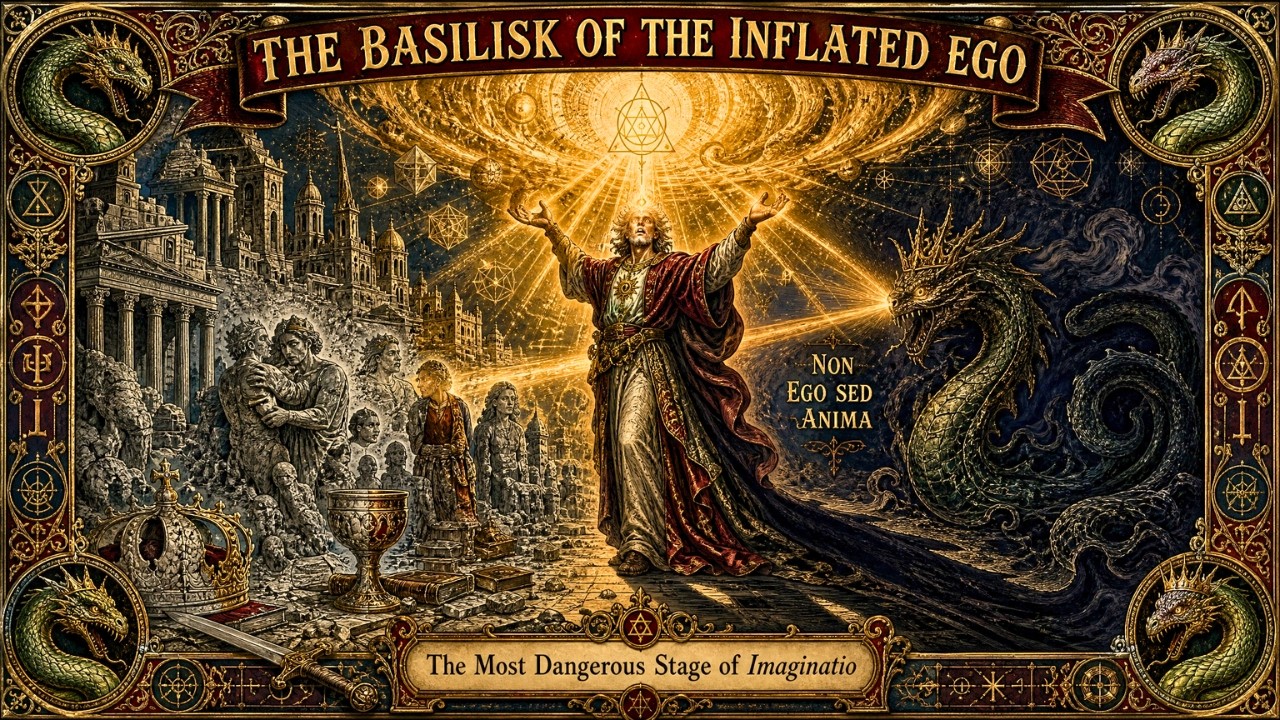
Psychological Inflation. When an individual first glimpses the power of Imaginatio Vera, the ego is tempted to commit the ultimate intellectual sin: hubris. The fragile ego mistakes itself for the ultimate source of this divine power. The individual becomes intoxicated by spiritual narcissism, viewing others with condescension, believing they can manipulate reality at will through mere mental demands. The alchemists symbolized this trap as the Basilisk, a creature whose gaze turns everything to stone. Psychological inflation freezes real inner growth. The universe eventually responds to inflation with brutal, uncompromising force — shattering the inflated ego through humiliating failure.
Possession by the Unconscious. When you open the doors to Imaginatio Vera, you are not merely engaging with peaceful, pleasing symbols — you are unmaking the protective walls that the ego carefully constructed to keep chaos at bay. If the conscious ego is weak, undisciplined, or morally compromised, it will be overwhelmed by the very images it seeks to master. Instead of the ego directing the imagination, the autonomous images of the unconscious hijack the ego. Paranoia is Imaginatio corrupted by fear. Obsessive jealousy is Imaginatio corrupted by insecurity. Chronic anxiety is Imaginatio run wild, constantly constructing vivid, terrifying scenarios of destruction. This is why the discipline of mastering emotions through alchemy and the alchemical map of anger must be understood before deeper work begins.
The Acor — The Dark Night of the Soul. During the transition from old passive habits to sovereign Imaginatio Vera, a horrifying vacuum occurs. The old world — the comfortable illusions, the distractions, the consensus reality of society — loses all its flavor and meaning. You suddenly see through the superficiality of social games and reactive living. Yet because the new integrated self has not yet fully crystallized, you are left suspended in a terrifying void. The hermetic philosophers called this state the Acor, the bitter sourness of the unrefined tincture. It is the moment where most people break, retreating back into comfortable distractions. To survive this crisis, the practitioner must realize that despair is not a sign of failure — it is the necessary death of the false self, the Mortificatio. The old structures must crumble completely so that sovereign, self-generated meaning can be forged from within. This is the same law governing the alchemical law of natural timing.
The Philosopher's Stone: The Integrated Psyche
The Lapis Philosophorum — the Philosopher's Stone — is not a physical rock that transforms literal lead into literal gold. It is an ancient, indestructible psychological center forged within the individual soul. It represents the fully integrated self: a mind that has united the conscious ego with the vast creative depths of the unconscious through the disciplined organ of Imaginatio Vera.
The individual who has achieved this level of integration possesses absolute internal sovereignty — no longer at the mercy of external chaos, outrage, or societal panics. They possess mastery over attention and energy, having permanently abandoned the wasteful disease of Phantasia. They experience a harmonious alignment of mind and world, recognizing that their environment is an organic extension of their internal state. And they activate true creativity — their output possessing a rare magnetic quality the ancients called charisma or the numinous, because their creations are born from genuine Imaginatio Vera bridging the deep collective archetypes with refined conscious execution.
Do not allow a distracted, trivialized world to convince you that you are a passive accident inhabiting a meaningless cosmos. Your mind is not a silent spectator trapped within the bone vault of your skull. It is a sacred, living laboratory.
Polish the mirror of your soul. Face the shadow in the quiet dark. Purge the passive noise of Phantasia and reclaim the sovereign Hermetic authority of Imaginatio Vera. For the universe is but the shadow cast by the eternal fire of the sovereign mind.
Go Deeper
Watch the complete teaching with visual symbolism and guided reflection on our YouTube channel.
Watch on YouTube Explore Ebooks